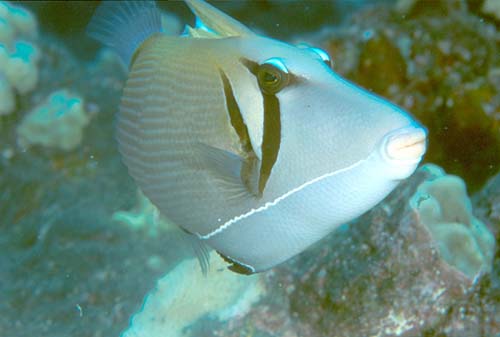
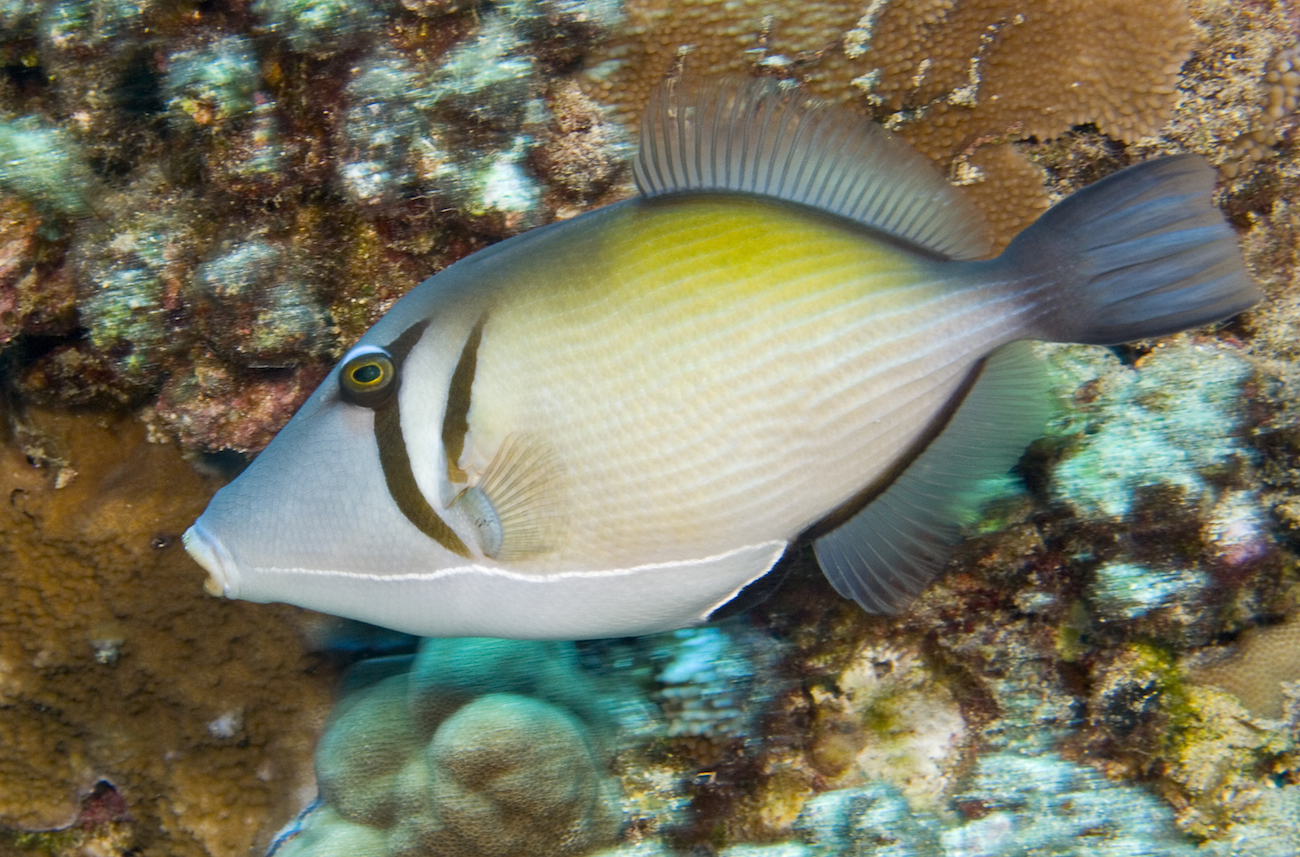
White stripe from mouth to base of anal fin. Double bar from pectoral fin over eye to base of pectoral fin. Body grey. A territorial fish that often attempts to charge divers.
Photos (not mine) and descriptions (not mine) of fishes and marine animals seen while snorkeling
Showing posts with label Triggerfish. Show all posts
Thursday, December 19, 2013
Sunday, September 9, 2012
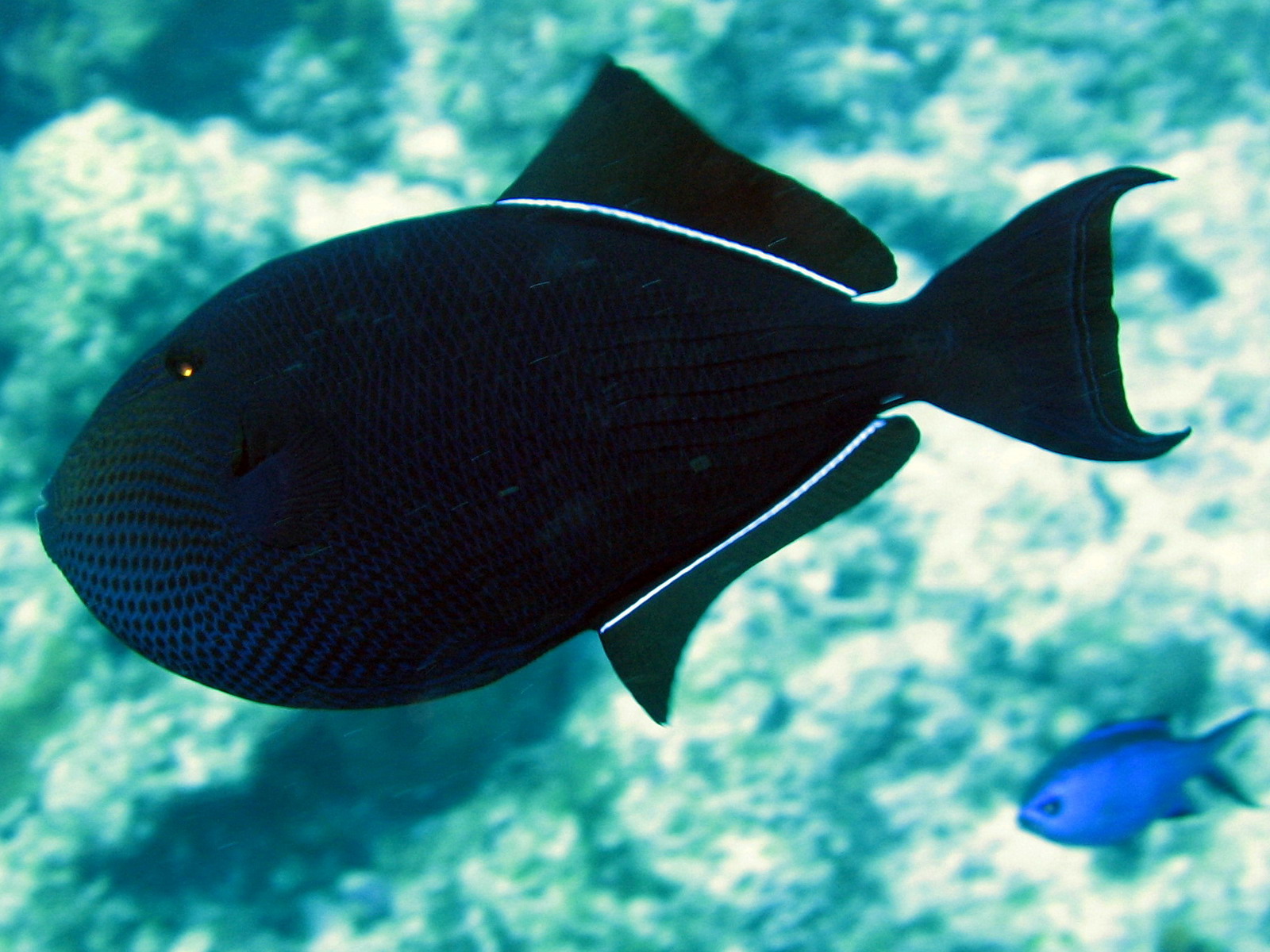
Humuhumu'ele'ele--Black Triggerfish
The black triggerfish is a blimp-shaped with bright white lines running along its doral and anal fins. When in the water, it appears to be completely black. However, if it is taken out and exposed to bright light, one can see that it is actually of a dark-blue/green coloration.

It is a common aquarium fish
Humuhumu hi'ukole--Pinktail Trigger Fish
Isn't this a beautiful fish!!!
This Triggerfish is named for its "pink tail". The body is so dark it looks black, but in reality it is a very deep forest green color. The dorsal and anal fins have a translucent pinkish-white appearance marked with dark bands at the outside edges, and the pectoral fins have a yellowish color to them.
|
A shy fish.
Sunday, January 16, 2011
Humuhumu'ele'ele--Black Durgon or Trigger Fish
A beautiful fish!!
The black triggerfish, Melichthys niger, called Humuhumu'ele'ele in Hawaiian, is a blimp-shaped triggerfish with bright white lines running along its dorsal and anal fins. When in the water, it appears to be completely black. However, if it is taken out and exposed to bright light, one can see that it is actually of a dark-blue/green coloration.
Triggerfishes have a very characteristic way of swimming, propelling themselves through
the water using waving motions of the broadened dorsal (top) and anal (bottom) fins. This kind
of swimming allows them great maneuverability. They can go forward, backward, or even hover
over the reef, but they cannot swim at great speed at length. Thrust for a quick dash into the
protection of the reef is made is made using the broom-like tail. When pursued by a predator,
triggerfishes sometimes make grunting sounds which may serve to warn nearby triggerfish of
danger. The eyes of these wary fish are set high on their heads and can move independently, so
that they can scan the reef for food and predators.
When threatened, a triggerfish dives into a hole or crevice in the reef and wedges itself
into the shelter by erecting the large dorsal spine on the head. The spine is locked into place by a
second, smaller spine behind it and can only be unlocked by the fish itself. Another spine on the
fish's belly also extends to help wedge the fish securely into its shelter. Triggerfish also use this
wedging behavior at night, when they rest within the reef in a preferred shelter hole that they use
over and over.
Triggerfishes have fused teeth and can feed on hard-shelled animals like snails, corals,
shrimp and crabs, and sea urchins. The family contains some of the few fishes that can feed on
the long-spined sea urchins (wana). Their high-set eyes and tough skin allow them to approach
the urchin closely enough to grab the long spines in their teeth. They flip the urchin over and
attack it around its softer mouth area where the spines are shorter. Other triggerfishes feed on
sand-dwelling organisms which they locate by blowing water into the sand to uncover the hidden
prey. A few triggerfishes feed on zooplankton, the small animals that drift in the water above
the reef. The black triggerfish, for example, is often found 15 to 30 feet (4.5-9 m) above the
bottom, plucking food from the water along with the schools of plankton-feeding butterflyfishes
and others.
Triggerfishes have a very characteristic way of swimming, propelling themselves through
the water using waving motions of the broadened dorsal (top) and anal (bottom) fins. This kind
of swimming allows them great maneuverability. They can go forward, backward, or even hover
over the reef, but they cannot swim at great speed at length. Thrust for a quick dash into the
protection of the reef is made is made using the broom-like tail. When pursued by a predator,
triggerfishes sometimes make grunting sounds which may serve to warn nearby triggerfish of
danger. The eyes of these wary fish are set high on their heads and can move independently, so
that they can scan the reef for food and predators.
When threatened, a triggerfish dives into a hole or crevice in the reef and wedges itself
into the shelter by erecting the large dorsal spine on the head. The spine is locked into place by a
second, smaller spine behind it and can only be unlocked by the fish itself. Another spine on the
fish's belly also extends to help wedge the fish securely into its shelter. Triggerfish also use this
wedging behavior at night, when they rest within the reef in a preferred shelter hole that they use
over and over.
Triggerfishes have fused teeth and can feed on hard-shelled animals like snails, corals,
shrimp and crabs, and sea urchins. The family contains some of the few fishes that can feed on
the long-spined sea urchins (wana). Their high-set eyes and tough skin allow them to approach
the urchin closely enough to grab the long spines in their teeth. They flip the urchin over and
attack it around its softer mouth area where the spines are shorter. Other triggerfishes feed on
sand-dwelling organisms which they locate by blowing water into the sand to uncover the hidden
prey. A few triggerfishes feed on zooplankton, the small animals that drift in the water above
the reef. The black triggerfish, for example, is often found 15 to 30 feet (4.5-9 m) above the
bottom, plucking food from the water along with the schools of plankton-feeding butterflyfishes
and others.
Saturday, January 15, 2011
Humahumanukanukaapua'a--Hawaiian State Fish--Triggerfish

Humu has an attitude! Very territorial and will charge a snorkeler. Rich can tell you all about it.
I call him Mr. Blue Lips.
The reef, rectangular, or wedge-tail triggerfish, also known by its Hawaiian name, humuhumunukunukuāpuaʻa, or just humuhumu for short; meaning "triggerfish with a snout like a pig"), is one of several species of triggerfish. Classified as Rhinecanthus rectangulus, it is endemic to the salt water coasts of various central and south Pacific Ocean islands. It is often asserted that the Hawaiian name is one of the longest words in the Hawaiian Language and that "the name is longer than the fish."
The triggerfish's teeth are blue and they are set close together inside its relatively chubby mouth, it has a small second spine, which it can use to lock its main spine into an upright position. The triggerfish can wedge itself into small crevices and lock its spine to make it extremely difficult to get out. In addition, when fleeing from predators, the triggerfish will sometimes make grunting noises, possibly a call to warn other nearby triggerfish of danger at hand.
Triggers have the remarkable ability to rapidly alter their coloration. They can fade into a relatively drab appearance when sleeping or demonstrating submission while the coloration is often the most vivid when the fish is healthy and unthreatened by its surrounding.
One particularly interesting aspect of the fish's behavior is the ability to blow jets of water from its mouth. These jets help the fish find benthic invertebrates that may be buried under the substrate. Triggerfish can often be seen spitting sand from their mouths in order to sift through the material in search of edible detritus or organisms. Reef triggers are fairly aggressive and will generally not tolerate conspecific species in its general vicinity, thus the fish is often found solitary. This is particularly true in captivity. Triggers have the remarkable ability to rapidly alter their coloration. They can fade into a relatively drab appearance when sleeping or demonstrating submission while the coloration is often the most vivid when the fish is healthy and unthreatened by its surroundings.
Subscribe to:
Posts (Atom)