Pretty cute fish. Beautiful face, large orange spine near tail. The Naso Tang, also known as the Orange-spine Unicornfish, darkens with maturity. Naso Tangs from Hawaii are often more brightly colored than those found in other areas. As a juvenile, the Naso Tang from Hawaii is dark gray with a blue stripe following the dorsal fin and an orange stripe in the anal fin. When matured, the body takes on a reddish-brown tone and the juvenile striping is supplemented with additional color. The tail takes on a lyre shape with a yellow vertical bar towards the back. Two orange patches appear at the peduncle spines near the tail. The face undergoes the largest change. A thin, black mask forms between the eyes and mouth. The mask is outlined with bright yellow and the lips develop a reddish-orange color.
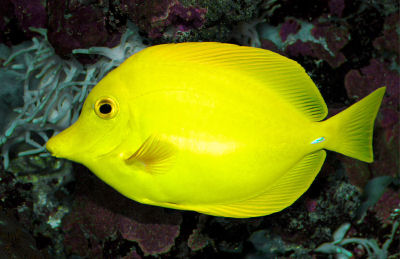
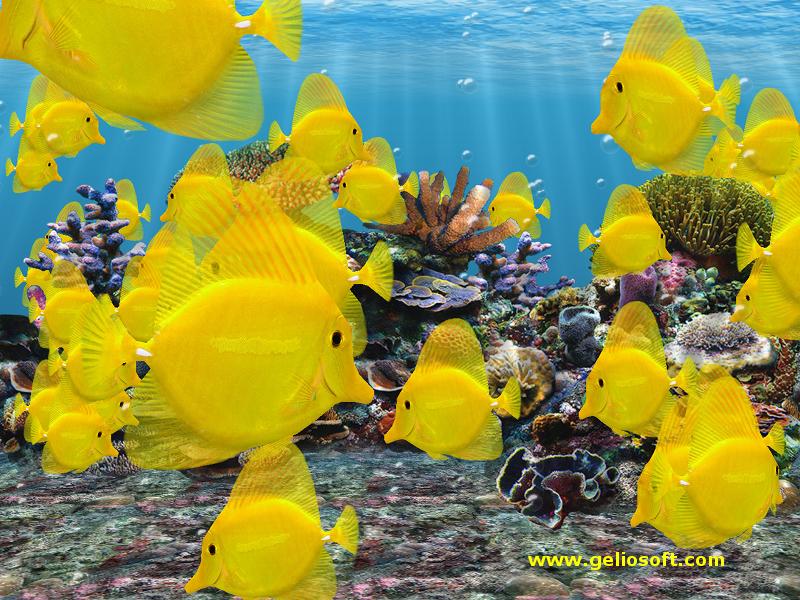
The second fish I noticed was the yellow tang (Zebrasoma flavescens).
Yellow tang are in the surgeonfish family. Adult fish can grow to 20 centimetres (7.9 in) in length, and 1–2 centimetres (0.39–0.79 in) in thickness. Adult males tend to be larger than females. All individuals of this species are bright daffodil yellow in color. At night, the yellow coloring fades slightly and a prominent brownish patch develops in the middle with a horizontal white band. They rapidly resume their bright yellow color with daylight.
They have an arrow-like shape due to their dorsal and ventral fins being almost an extension to their bodies, and a long snout-like mouth used (as with other tangs) to eat algae. They also have a sharp spine located near their tail. They have become a popular fish for marineaquarists of all skill levels, as the fish tends to be active, hardy, and nonaggressive when kept with dissimilar species.
They are commonly found in shallow reefs, from 2–46 metres (6.6–151 ft) deep, in the Pacific andIndian Oceans, west of Hawaii and east of Japan. Hawaii is the most common place for aquarium harvesting, where up to 70% of the yellow tangs for the aquarium industry are sourced from.
This is the first in a series of fish from snorkeling in Hawaii, namely Kahalu'u and Captain Cook. Rich and I love to snorkel and decided to catalogue the fish we have seen. The photos are not mine and the information is from Wikipedia.
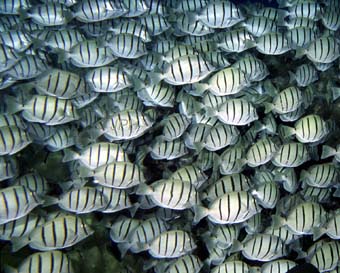
The Convict Tang was the first fish I noticed when snorkeling because of their large numbers.
The manini (Acanthurus triostegus) is a small surgeonfish. It is about 5 inches (13 cm) long. It is whitish-yellow with zebra-like black stripes on its side. Its resemblance to a prisoner’s uniform gave it the nicknames of convict surgeonfish and convict tang. Manini is a favorite food fish found in shallow waters around the islands of Samoa and the Hawaiian islands. Like the alogo (Acanthurus lineatus), manini are surgeonfishes, because of the sharp blades by their tail fin. They do not use this weapon much.
Manini often swim in schools of thousands. There are two reasons why they have large schools. First, It helps them escape predators. When a large fish attacks a school, they scatter like an explosion. This move confuses the predator and the prey escape. Each manini has another chance at life if they stay with the group. Second, most use their schooling to trap food. They like to feed on thin algae which is fiercely guarded by alogo and damselfishes. Just the sight of manini get the alogo fired up. A single manini would not have a chance against these predators while a group can succeed. When the alogo chases one manini, the rest of them eat the alogo’s garden of algae


 Pretty cute fish. Beautiful face, large orange spine near tail.