This fish feeds in the shallows close to shore and is so common and unremarkable in color that few pay it any attention. Nonetheless, it is a fascinating animal.
It varies from dark brown to light grayish brown with a definite lavender tinge, especially on the fins. There are dull orange spots on the head and two dark spots at the base of the tail, one above the other. The tail fin is lunate (crescent-shaped). When displaying aggression its upper back and the entire dorsal fin lighten, sometimes becoming distinctly yellow.The species name nigrofuscus means "dark brown." The Hawaiian name refers to a variety of kalo (taro).  This is the most common fish at Kahalu'u. 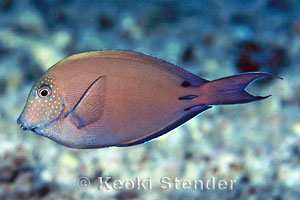 |
Showing posts with label Surgeon Fish. Show all posts
Showing posts with label Surgeon Fish. Show all posts
Sunday, September 9, 2012
Kalo--Brown Surgeon Fish


Kole--Goldring or Yellow Eyed Surgeonfish
Saw these beautiful fish at Captain Cook


This dark colored surgeonfish is distinguishable by its fine, horizontal striping, yellow eye-ring and blue lips. It is endemic (that is unique) to the Hawaiian Islands and Johnston Atoll.
Goldring are diurnal herbivores that browse on filamentous seaweeds and diatoms covering the seafloor. Their mouths have bristle-like teeth giving rise to one of their groups’ common names––“bristletooths”
Goldring bristletooths are one of the two most common species seen at turtle cleaning stations where they browse on the algae and diatoms coating the turtle’s carapace. Goldrings appear to prefer the algae growing on the hard parts of turtle’s bodies, while closely associated yellow tang prefer algae from the soft parts. The behavior of these respective species is indicative of one way that closely related species specialize, thereby avoiding competition for similar resources.
Interestingly, while browsing on turtles, Goldring bristletooths will tolerate the presence of divers much closer than while feeding in schools or on their own.


Saturday, January 15, 2011
Na'ena'e--Orangeband Surgeonfish


Found in the Western Pacific and around the Hawaiian Islands, the Orangeband Surgeonfish is marked by a distinct orange band edged in blue just behind its upper gill cover. The rest of their body is light gray in color. They are voracious algae eaters. This is one of the few Tangs that undergoes a radical change in coloration from juvenile to adult stages.
The juvenile is almost solid yellow, while the adult is a two-toned blue/gray with an orange stripe at its "shoulder". Relatively peaceful, it will tolerate other types of Tangs, but should be the first one in the aquarium.

Subscribe to:
Posts (Atom)