Thursday, December 19, 2013

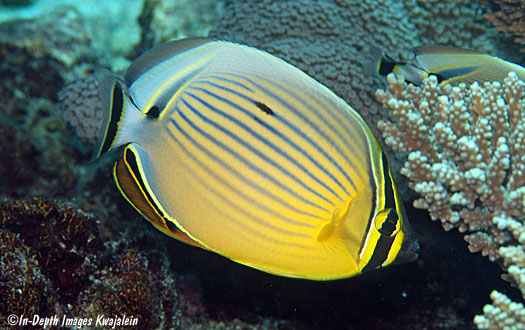
Kapuhili--Oval or Redfin Butterflyfish

Rich and I saw a pair of these at Two Steps.


 Vertical black eye bar, bluish stripes on body, distinctive red anal fin.

An uncommon species that almost exclusively occurs in pairs.


Kikakapu--Pebbled or Multiband Butterflyfish

There were many of these at Two Steps.

Black eye-bar, small black band at base of tail and edge of tail and five beige verical bands on its cream colored body. These bands can appear at times only faintly.


Wednesday, December 18, 2013

Puhi--Dwarf Golden Moray

Sarah found this little moray at Two Steps today and showed it to me. Quite cute, but before we went snorkling, we went to a dive shop and while talking to one of the sales ladies, she showed us a bandaged finger. She was scuba diving and a moray eel attacked her finger. She had to have 33 stitches and says she has no feeling in her finger.


Small size, mustard colored head, sometimes dark markings on the body, and iridescent blue iris. Usually no longer than 10 inches. A shy, but common species that is seldom seen in the open.


Monday, December 16, 2013

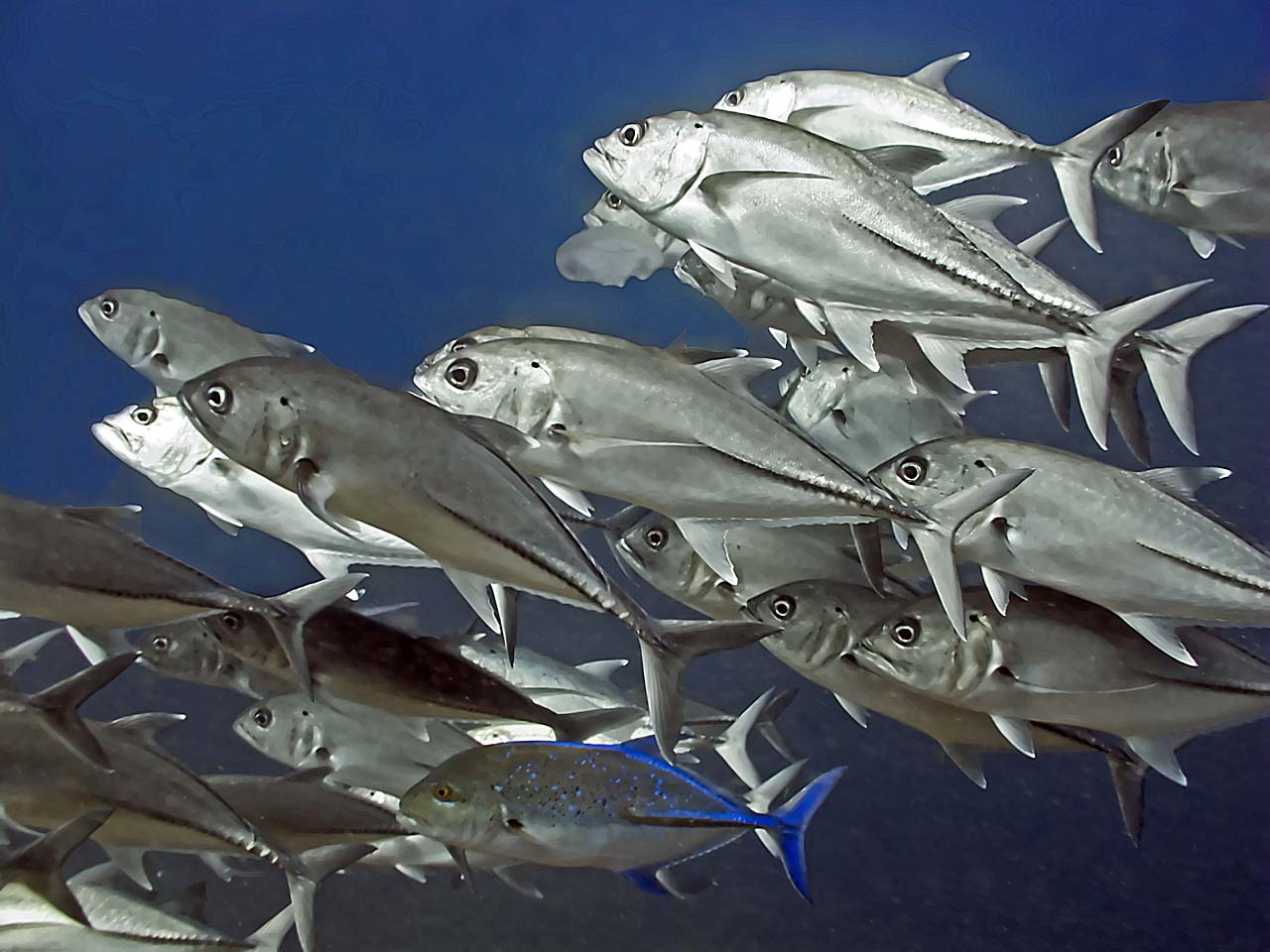
Big Eye Jack or Trevally

Rich saw these right at the rocks where the waves were crashing. It was a big school of hundreds.


I tried to get close to see them but was pounded by the waves. By the time I got there, they were gone.


From Wiki" It is predominantly an inshore  fish, inhabiting reefs down to depths of around 100 m in both coastal zones and offshore islands, often venturing into estuaries and sandy bays as juveniles. The bigeye trevally is commonly found in large slow moving schools during the day, becoming active at night when it feeds, taking a variety of fish, crustaceans, cephalopods and other invertebrates. The fish is known to move from a more crustacean dominated diet as a juvenile to a nearly completely fish dominated diet as an adult. 

The bigeye trevally is of moderate importance to fisheries throughout its range, and being of high importance to some artisanal fisheries. It is taken by gill net, hook and line and other artisanal fishing methods. It is rated as a fair to good table fish.

The bigeye trevally is a schooling species, known to form aggregations consisting of more than 1500 fish. The species is often seen in these large schools either stationary or slowly moving around the reef complexes they inhabit during the day. At night, these schools dissolve, and the species become active, taking most of its prey  during the nocturnal period.This contrasts to most jacks, which are generally diurnal hunters, although the species has been documented hunting in shallower waters during the day, especially as juveniles. 

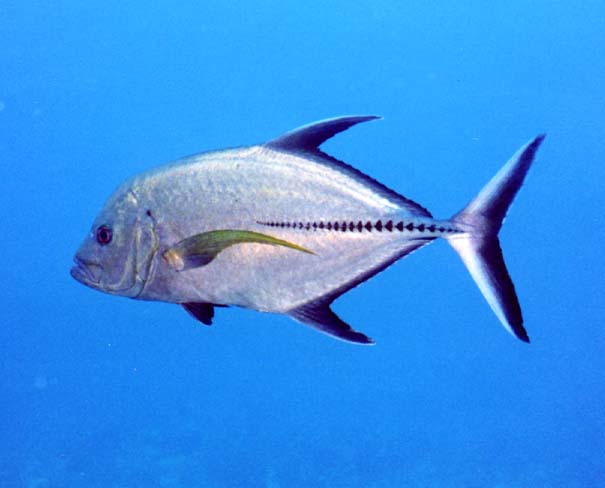
Ulua la'uli--Black Jack or Trevally

Rich and I see these occasionally at Kahalu'u. They are usually solitary.


Jacks of the genus Caranx, often called trevallies, have prominent scutes—a line of strengthened scales that reinforce the tail. The scutes of the Black Trevally, or Black Jack, are especially easy to see. These jacks vary from almost black to dull gray, but the scutes are always dark. There is a dark spot on the upper gill cover. The species occurs singly or in pairs, typically along steep dropoffs adjacent to deep water. 


Ula--Hawaiian Spiney Lobster

How exciting to see a spiney lobste!. Rich pointed him out to me. He was large and crouched  down between two rocks. All we could see was antennae and legs.

NPS photo - Bryan Harry


From the Waikïkï Aquarium: 
 Hawaiian spiny lobsters are important predators and scavengers in the reef community. 
They are usually found under ledges or in caves with only their long antennae sticking out. These 
large crustaceans use sound to warn other lobsters, and even human divers, away from their shelter 
on the reef. The lobsters produce a grating or buzzing noise by rubbing hard pads at the base of the 
antennae against special ridges on their head - an activity called stridulation. Lobsters remain in
their shelters during the day and emerge at night to forage over the reef.

Sunday, December 15, 2013

Po'opa'a--Stocky Hawkfish

Rich saw this fish yesterday. He is the best at spotting fish! Usually finding them and showing me.


He is the largest hawkfish. Average size is 9-11 inches. He has a mottled body with yellow lines on face and red spots on body.